
The Hidden Tax on Blue-Collar Workers and Building in America
The Problem
Americans are concerned that many parts of life have become increasingly unaffordable, especially housing. The United States lacks a sufficient supply of houses, which drives up rent and makes it difficult for people to buy their own house and achieve the classic “American dream.” Building more housing will likely require a larger construction workforce, but these employment opportunities are actively impeded by our ill-designed unemployment tax system.
Unfortunately, the U.S. unemployment insurance system has a design flaw that penalizes the construction industry, leading to fewer workers and lower productivity. Over time, that means less – and more expensive – housing.
Most people know of unemployment insurance purely through the benefits side. If you lose your job, unemployment insurance will provide you with a temporary income to help you get back on your feet. But few people are familiar with how unemployment insurance is paid for: a Byzantine tax system that – through a quirk of its design – is disproportionately borne by blue-collar workers in the construction industry.
Construction jobs face roughly $1,000 more in unemployment insurance taxes each year than jobs in other industries.
By eliminating or reducing this penalty, we can support the construction industry and workers while also simplifying and rationalizing our social insurance system. Greater employment opportunities and wages are possible.
The Design Flaw: Why Construction Pays More
Understanding Unemployment Insurance Experience Rating
The unemployment insurance (UI) system is a federal-state partnership. The federal government pays for the administrative costs of running the unemployment system, and sets general standards for how the system works. States pay for the actual unemployment benefits, and get to design both the benefits and taxes within the federal guidelines.
Unlike programs such as Social Security or Medicare, which apply employer- and employee-side taxes, unemployment insurance is almost exclusively funded by a tax on firms. States can choose among several different program formats that have been approved by the secretary of labor. Most states use one of the following two models:
- Reserve Ratio: With this model, state programs maintain a separate UI account for each individual employer in the state. Each firm pays taxes into that account, and former employees receiving UI benefits will have their payments drawn from that account. The tax rate for the employer is determined by the current funds in the account – firms with a positive balance will pay less and firms with a negative balance will pay more.
- Benefit Ratio: Under this model, employers do not have separate account balances, and UI is paid out of a statewide joint account. However, the total cost of UI payments attributed to each firm is tracked across the last several years. That aggregate cost is then compared to the total wage base of the firm to create a “benefit ratio” (i.e., how much are workers from those firms drawing upon benefits, as a ratio of total payroll eligible for the tax). The benefit ratio then determines the tax rate in the next year, with firms that have a higher benefit ratio assigned a higher tax rate.
Both of these tax models are “experience rated.” This means that the tax rate for any given firm is determined by an assessment of the unemployment risk of the firm’s employees, using one of the approved metrics. Firms with workers who are more likely to make use of the unemployment insurance system pay a higher rate.
By design, this tax structure aims to provide firms with a financial incentive to stabilize their \workforces, encouraging them to avoid layoffs and, by extension, reduce their reliance on the unemployment insurance system. The goal of this tax structure is to incentivize firms to be less likely to fire workers, and thus be less likely to rely on unemployment insurance.
But, as is often the case, firms can respond to this incentive in ways the original policymakers did not anticipate. For example, firms are less likely to hire “risky” employees, such as younger, entry-level workers who are more at risk of being laid off. They are also more likely to deny benefits to workers by getting them to quit, hiring consultants, or tangling them up in paperwork. Higher taxes will simply cause fewer workers in general to be employed – when we tax something we get less of it.
Why This Matters for Construction
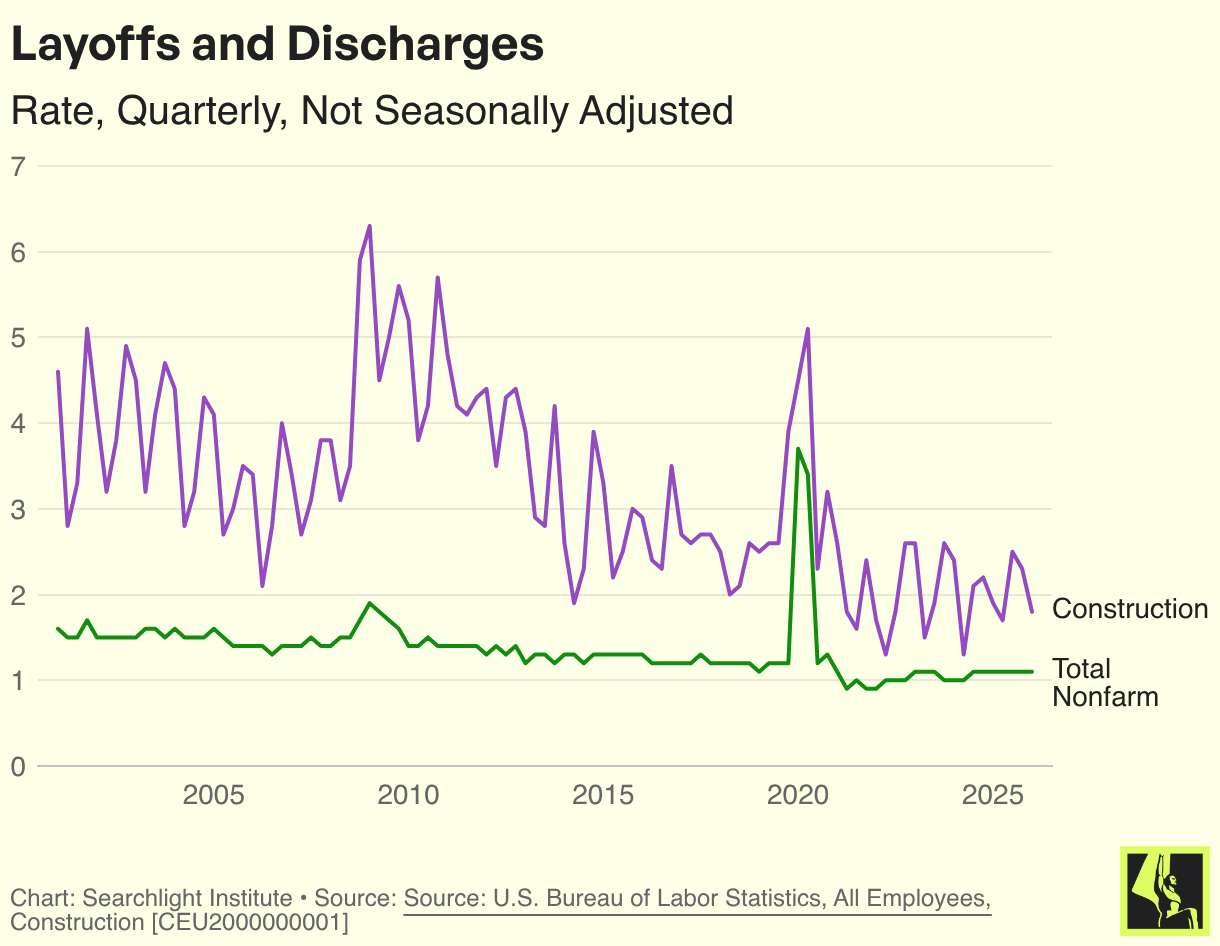
This tax design hits the construction industry especially hard. Construction firms typically have around double the layoff rate compared with the overall labor market, which means that they are more likely to draw on the unemployment insurance system.
This isn’t because of something unique to decision-makers within the construction industry. They aren’t more likely to fire workers because managers are especially easy to anger. Instead, it’s because of specific structural issues within the construction industry.
Construction is highly seasonal: Construction work is necessarily outdoors, making it more seasonal than almost any other industry. Much of the work is done during the warm summer months, while there is less construction in the winter. As a result, the construction workforce size is highly dependent on the season. Over the course of a year, effectively 10% of employees leave the industry during the winter months and return in the spring.
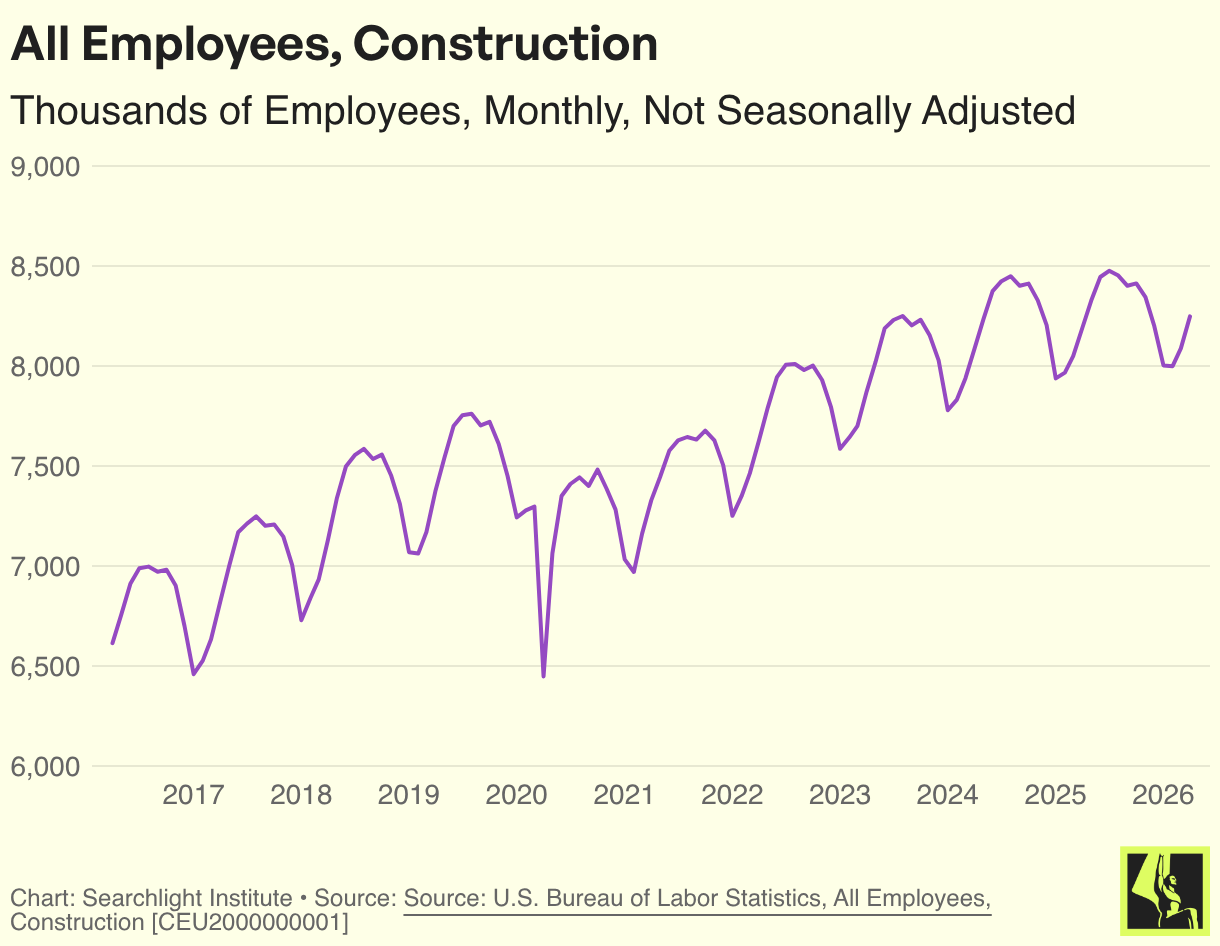
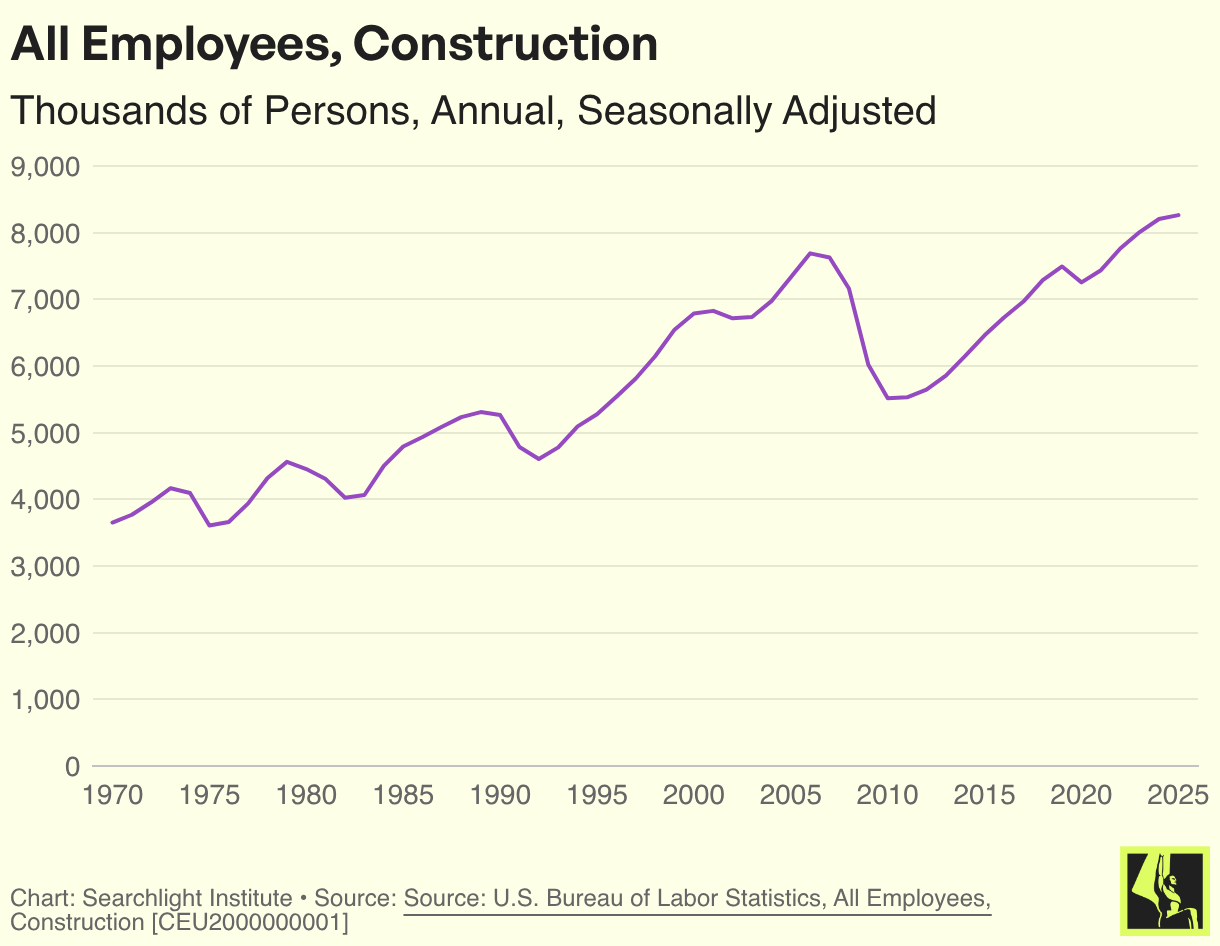
Construction is highly dependent on the business cycle: If the seasonality wasn’t bad enough, construction is also highly variable over the longer-term business cycle of economic expansion and contraction. Building a house is effectively an investment product and, as such, is sensitive to interest rates. The economist Ed Leamer famously argued that housing is the business cycle.
The result of this is that the layoff rate in the construction industry is very high – roughly double the rest of the labor market.
Average Tax Rates
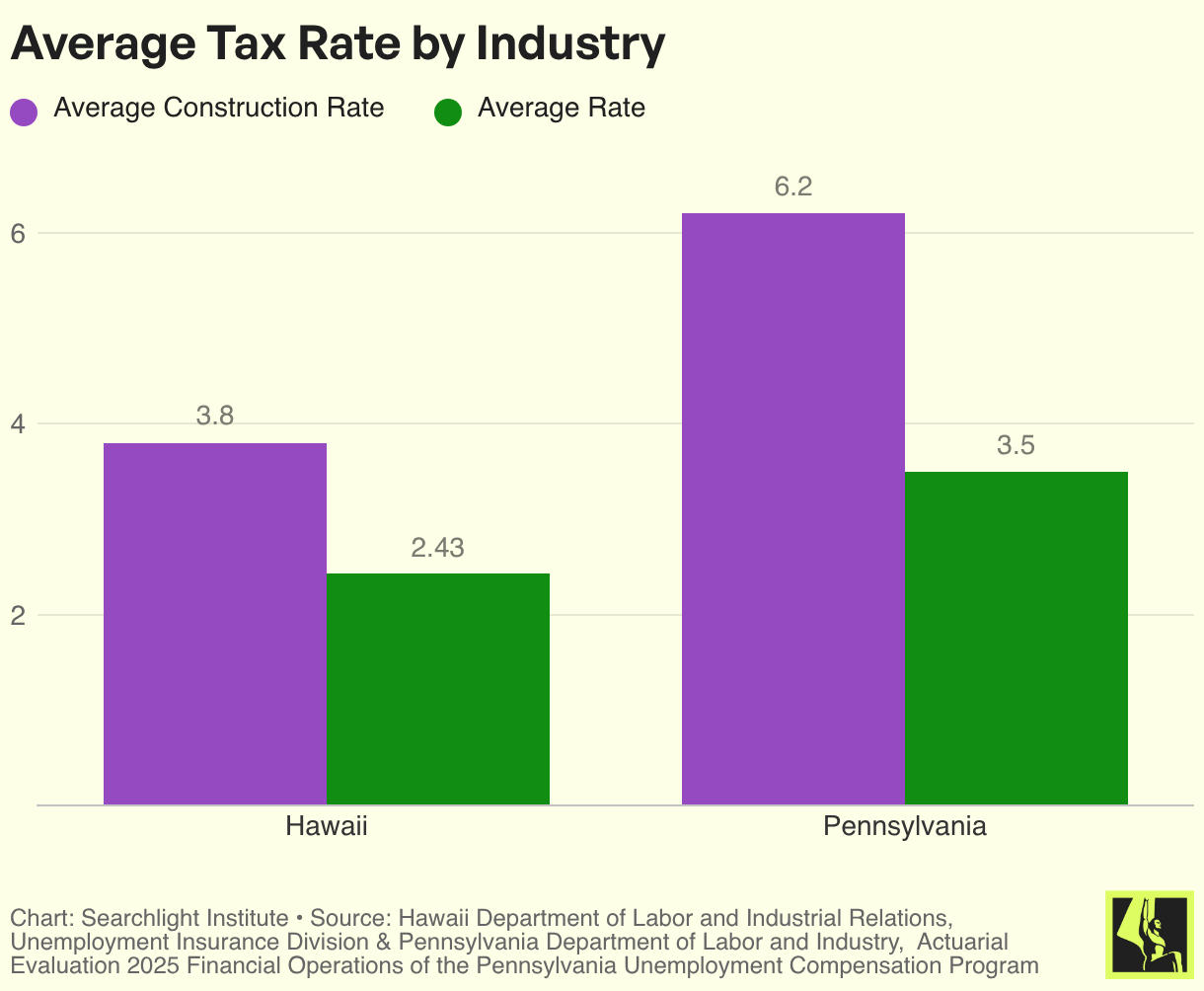
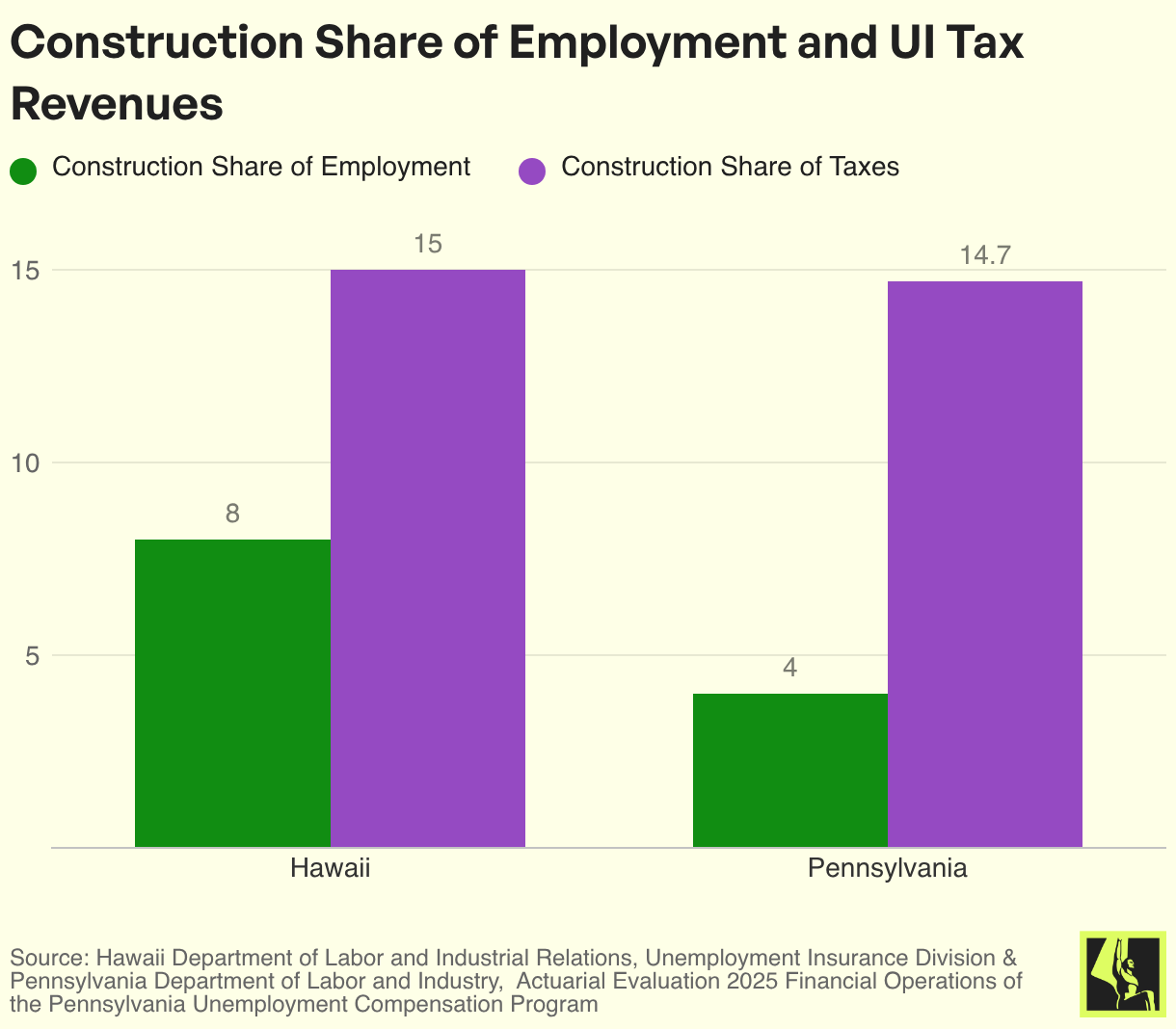
These layoff dynamics result in the construction industry paying a higher tax rate. Two states, Hawaii and Pennsylvania, have particularly detailed information about UI tax rates and revenues by industry. In Hawaii, the most recent report showed that the construction industry paid a 3.8% tax rate on average, compared with the statewide average of 2.4%.
In Pennsylvania, the construction industry paid an average tax rate of 6.2%, compared with the statewide average of 3.5%. In both cases, the construction industry had a tax rate over 150% of the statewide average.
We can also look at total revenues. In Hawaii, 38,071 people worked in the construction industry, or about 8% of total employment. In the same year, the construction industry paid $73 million in state UI taxes, or 15% of total taxes. Because construction workers are typically paid less than the average employee, and Hawaii only applies UI taxes to the first $59,100 of income, the tax rate understates the total shift in resources. On average, the unemployment insurance tax on each construction worker is $1,912 in UI taxes, double the tax on non-construction employees, $947.
Pennsylvania tells a similar story: 263,000 people worked in the construction industry, or 4% of total employment. But the construction industry paid $296 million in state UI taxes – 15% of the $2 billion total. Pennsylvania has a very low UI tax base; taxes are only applied to the first $10,000 of income. The total average UI tax paid is $1,126 per construction worker and $289 for everyone else. Construction businesses pay around four times the taxes per worker as everyone else.
New Employer Tax Rates
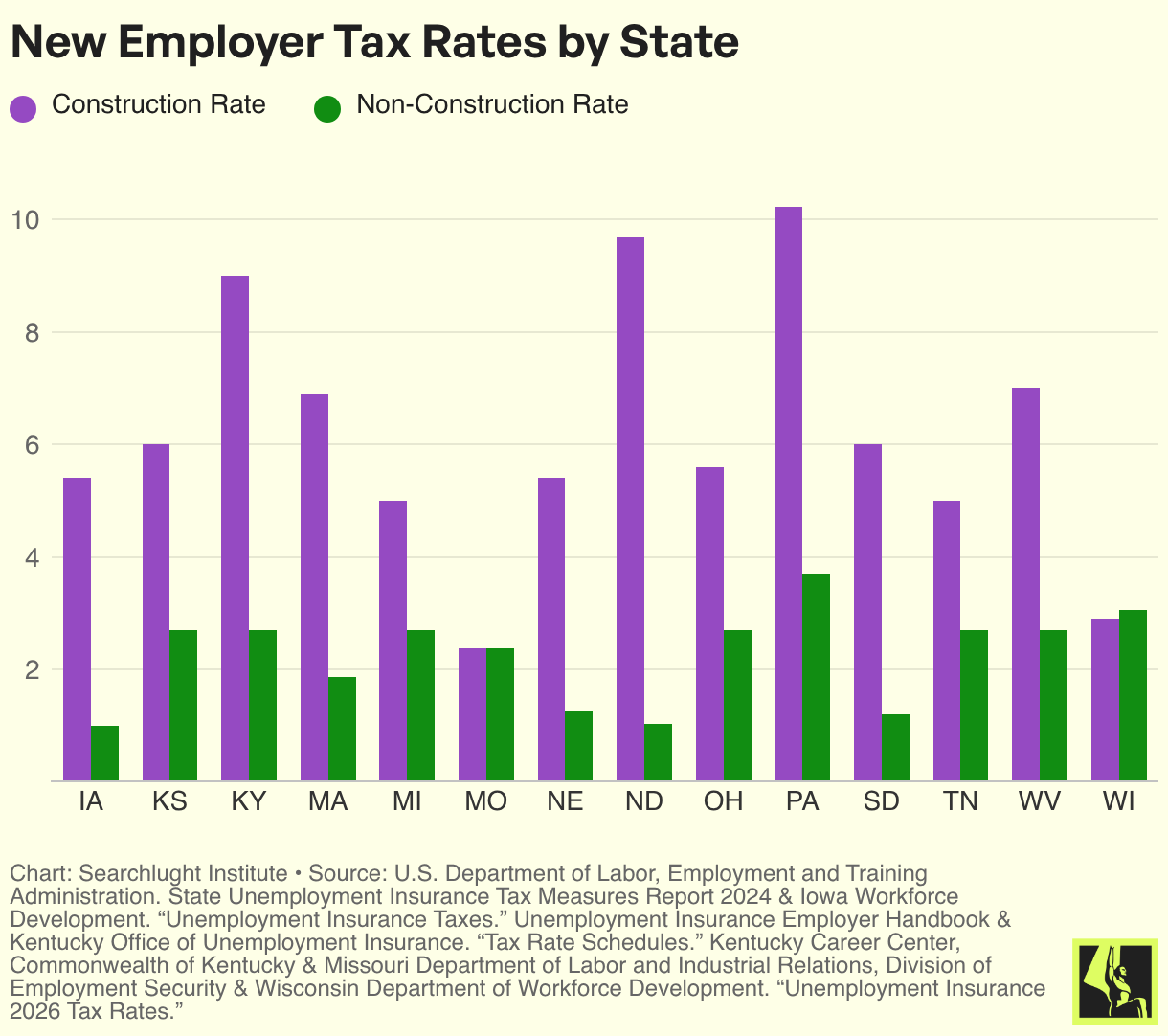
Most states do not provide this sort of fine-grained detail about the differences in UI taxes by industry. However, states do publish the UI rate for new employers. While each individual firm can have its own unique tax rate based on its individual layoff history in an experience rating system, new employers have no history, and states must assign them to a publicly available default rate.
Sixteen states have a separate breakout for new employers of construction workers. In some states, construction firms are required to pay the average rate across the industry. In other states, the construction rate is set by statute. Across all states with a separate breakout for the construction industry as a whole, the most recent data had the construction industry paying a 6.2% rate, while non-construction industries paid a 2.3% rate The exact tax difference between new firms in construction and non-construction industries varies by state. In Wisconsin, new construction firms actually paid slightly less than non-construction firms. Meanwhile, the tax rate paid by new construction firms in Iowa was over five times greater than non-construction firms.
State UI Rules
We can also look at state UI rules to see that this difference is fairly consistent across states – even those that have not publicly released their UI rates by industry. State UI laws are available and their impact on tax rates can be modeled.
Robert Pavosevich, the former lead actuary in the Office of Unemployment Insurance of the Employment and Training Administration, created a framework to estimate the total increase in taxes for a firm, based on the firm’s layoffs, size, wages, and other assumptions.
For example, based on the JOLTS layoffs data, a construction company with 20 workers will lay off six workers in the average year. The average non-construction company would only lay off three. According to Pavosevich’s calculator, the subsequent increase in unemployment insurance taxes would be double for construction companies in almost every state or territory.
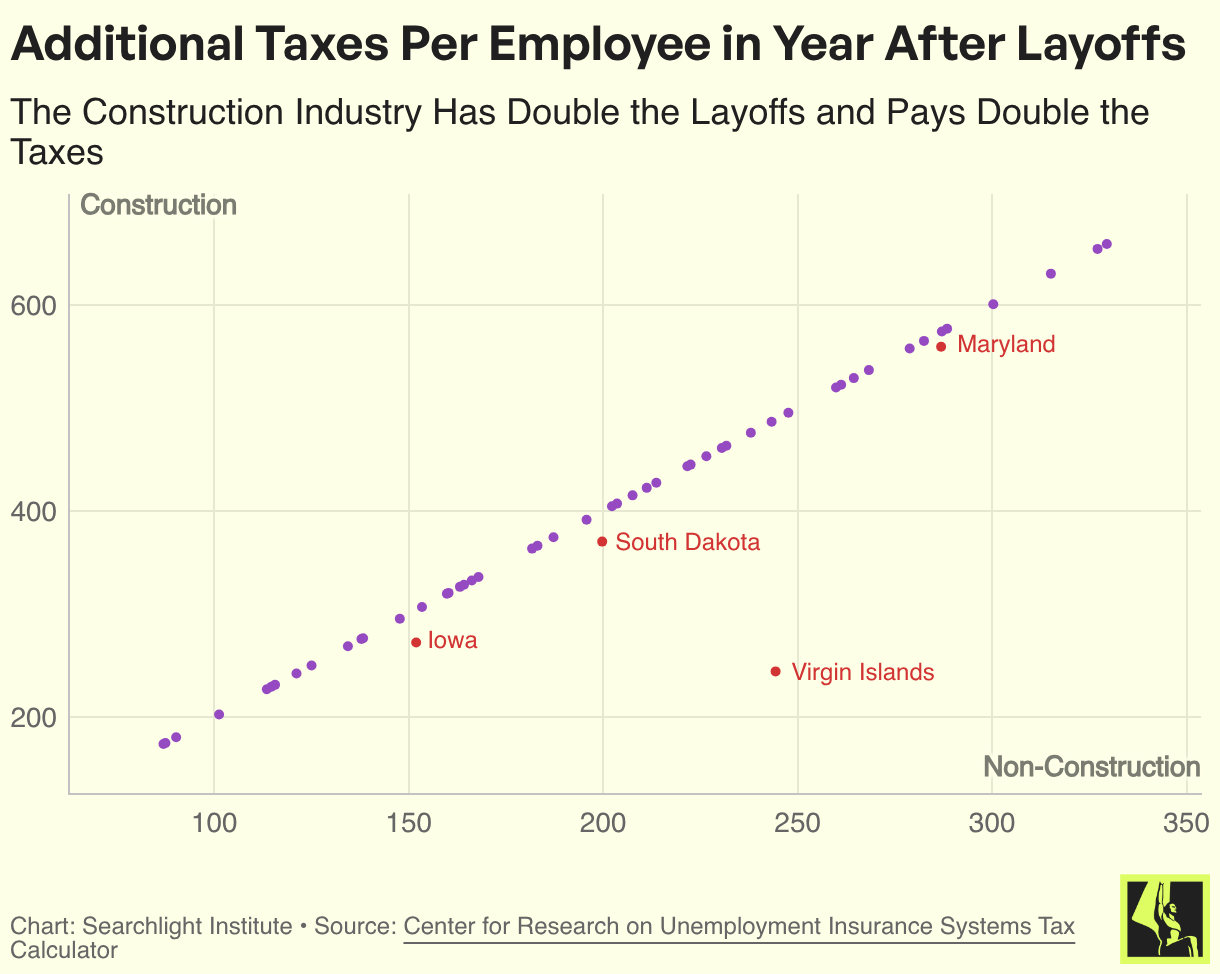
The exceptions are states and territories (Iowa, Maryland, South Dakota, and the Virgin Islands) that have lower maximum tax rates. In these states, a construction firm that had the average industry layoff rate would hit the state’s maximum tax rate – even if the firm had not had any layoffs in the previous year. In the case of the Virgin Islands, both the construction and non-construction firms would hit the maximum rate in a year of average layoffs, such that the rates of both companies are identical.
The Economic Damage of High UI Taxes
The additional UI taxes paid by construction firms can be costly – not just for the firms, but also for workers and the economy itself. This additional tax burden can lead to:
- Decreased Wages: Payroll taxes that are levied on firms (such as the taxes used to finance UI) can have the effect of reducing the wages of workers. Even though it is the firm that is responsible for paying the tax, the firm can react to a tax increase by reducing worker pay.
- Decreased Employment: Some economists have found that high UI taxes can reduce employment, instead of reducing layoffs as intended. Firms may simply be less likely to hire employees, especially “risky” employees like entry-level workers.
- Fewer Firms: Firms in states with higher UI taxes are less likely to exist in the first place. Doubling entry-level UI taxes reduces the number of new construction firms entering the market by 20%, which is twice the effect on non-construction firms.
- Fragmented Industry: Different speciality areas within construction will have different layoff rates. For example, some of the highest layoff rates are related to work involved in site preparation and masonry – work that cannot be conducted during permafrost. In order to avoid being charged for these higher layoff rates, more generalist construction firms will subcontract that work out instead of hiring in-house. As a result, the construction industry is uniquely fragmented. Almost 90% of construction firms are small, with 10 or fewer employees.
- Decreased Productivity: While most industries in the United States have seen their productivity increase over time, construction is unique in that its productivity has actually decreased over the last several decades. As of 2020, construction productivity was somewhat below the level it was in 1950, while manufacturing productivity increased nine times above its 1950s base. Experience-rated UI taxes may be an important contributor to this phenomenon. While it may not be possible for construction to achieve the same economies of scale as manufacturing, larger builders can still benefit from improved process management, investments in technology, and relationships with vendors and politicians. This is difficult under an experience rated UI tax regime. The construction industry is primarily small subcontractors working together on temporary projects, in part, because experience rating incentivizes firms to limit their exposure to high-layoff subindustries. Firms based in states with higher UI taxes are more likely to rely on contract labor (who are not eligible for UI) instead of hiring permanent employees.
- Decreased Housing: The net effect of all of the factors above – fewer employees, fewer firms, a fragmented industry and decreased productivity – contributes to the lack of affordable housing in the United States. If employment in the construction industry was more available – especially in large, vertically integrated firms looking to reduce costs and increase productivity – it would be easier to build new housing in America.
Public Opinion on Reforming UI Taxes
Despite the wide-ranging effects of UI taxes, few Americans are familiar with the details of the unemployment insurance financing system. Because the tax is paid at the firm, workers do not see the money coming out of their paycheck. Firms themselves may not entirely understand how the system works either, and only see how their rate fluctuates year to year. Searchlight surveyed likely voters to determine if they would support changes to this opaque yet consequential tax system.
We polled two versions of a question asking Americans what they think about the use of experience rating in unemployment insurance. In the first version, we gave a neutral description of the system.
The money for unemployment benefits are paid for by a tax on firms. Firms that lay off their workers more often have to pay a higher tax rate than other firms. Economists believe that some of these higher costs are passed on to workers through lower wages.
In the second version, we emphasized that these taxes fall more heavily on blue-collar workers, such as those in construction.
The money for unemployment benefits are paid for by a tax on firms. Firms that lay off their workers more often (primarily blue collar industries such as construction and manufacturing) have to pay a higher tax rate than other firms. Economists believe that some of these higher costs are passed on to workers through lower wages.
Americans as a whole are mostly split on their approval of the system, under both descriptions. Under the neutral description, 33% of Americans approve, 37% disapprove, and 30% have no opinion. In the framing that emphasizes that the effects primarily fall on blue-collar workers, there is a small shift to 32% approval, 42% disapproval, and 26% neutral.
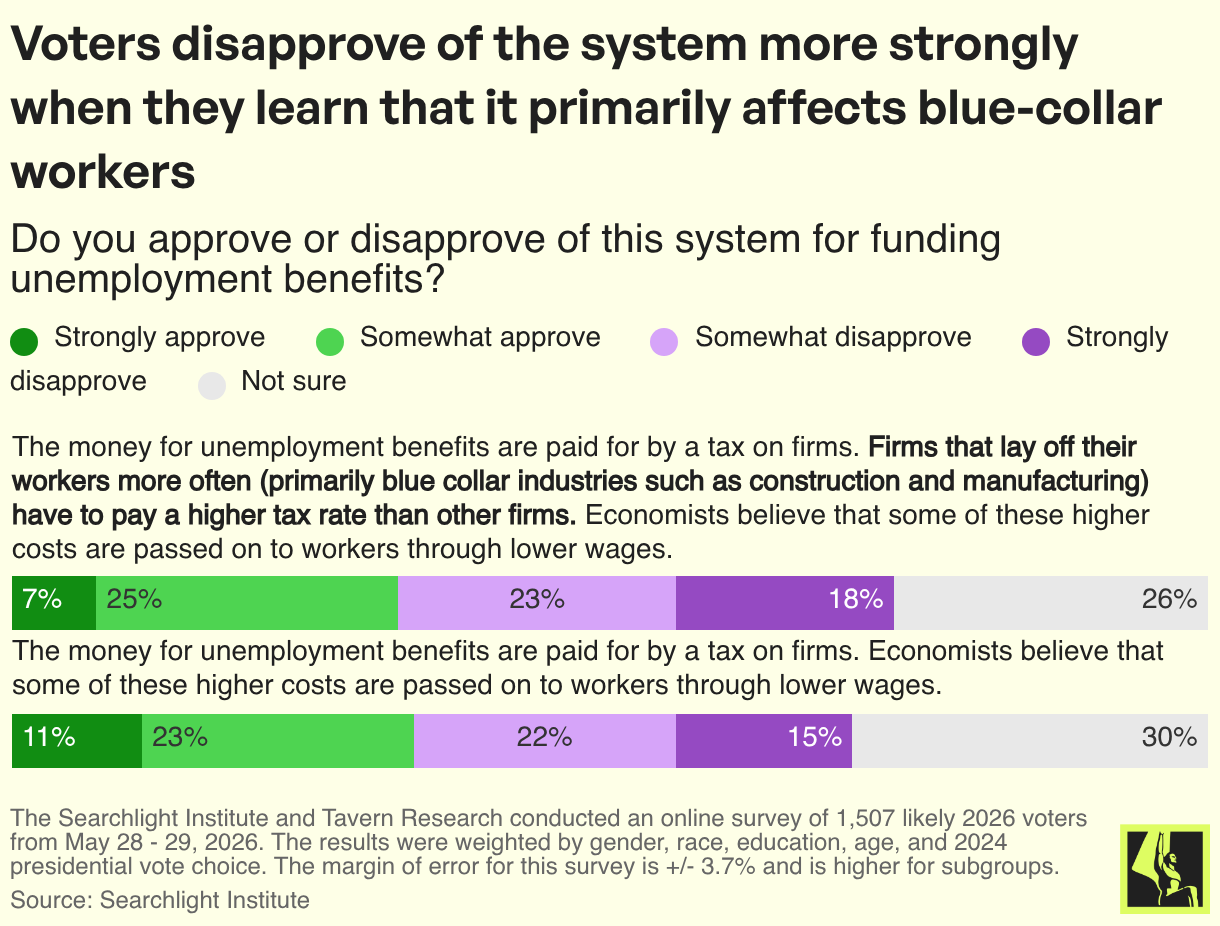
But only looking at the aggregates hides a divergence between Americans who did and did not go to college. Americans who do not have college degrees are more likely to disapprove of the experience rating system, shifting from 34% disapproval in the neutral framing to 43% in the framing that focuses on blue-collar workers.
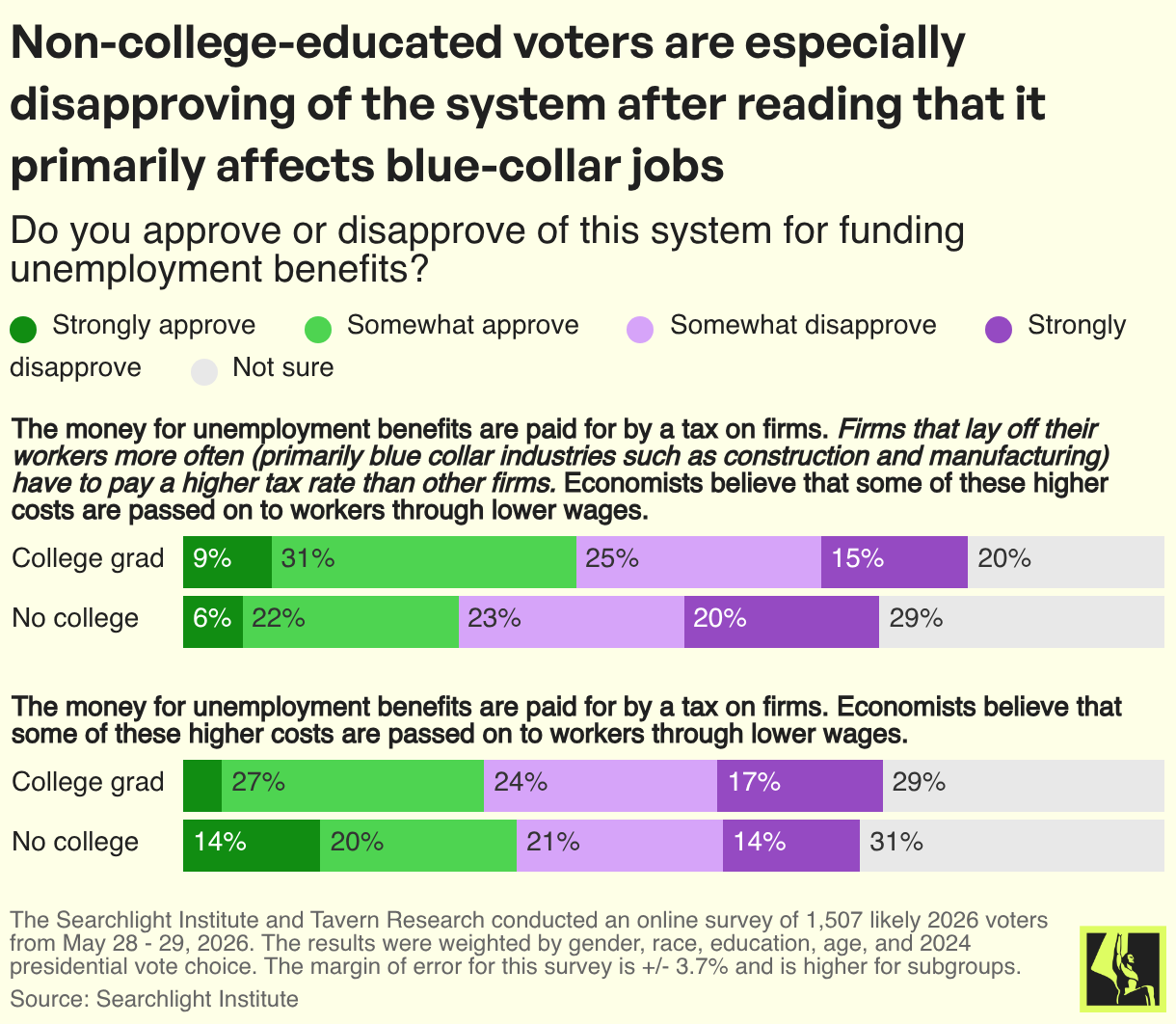
This suggests that when experience rating is framed as a tax that primarily impacts blue-collar workers, opposition to the policy solidifies, particularly among the non-college-educated workers most impacted by the tax.
Policy Recommendations
Policymakers could reduce the negative impacts of experience rating on the construction industry through several different avenues.
-
- States: States have substantial capacity to minimize the effects of experience rating on their own, without changes to federal law. First, they could modify their systems to minimize the impact on the construction industry, such as increasing the wage base used for taxes while lowering the rates. This would reduce the impact on lower-wage firms and shift the tax from an effective per-worker head tax to an actual payroll tax, while keeping total revenues constant.More directly, states could change the rate at which taxes increase for employers. While states are required to use an experience rated system, states do have flexibility in exactly how steep and quick the tax increase is when former workers claim benefits. States also could shift between the four approved experience rated systems. Notably, most states currently use the reserve ratio system, which has the highest disincentives for hiring.
One way to reduce the impact on construction specifically would be to look for ways to reduce the impact of seasonal effects. For example, the “payroll variation” method used by Alaska looks at changes in payroll quarter to quarter. A system that instead factored in measured payroll changes year over year would reduce the additional taxes levied on construction firms and other seasonal employers, while preserving them for firms that had large, permanent layoffs. While no state is currently using a payroll variation program looking at changes year over year, such a system has already been approved by the Department of Labor.
- States: States have substantial capacity to minimize the effects of experience rating on their own, without changes to federal law. First, they could modify their systems to minimize the impact on the construction industry, such as increasing the wage base used for taxes while lowering the rates. This would reduce the impact on lower-wage firms and shift the tax from an effective per-worker head tax to an actual payroll tax, while keeping total revenues constant.More directly, states could change the rate at which taxes increase for employers. While states are required to use an experience rated system, states do have flexibility in exactly how steep and quick the tax increase is when former workers claim benefits. States also could shift between the four approved experience rated systems. Notably, most states currently use the reserve ratio system, which has the highest disincentives for hiring.
- Department of Labor: The labor secretary has to approve state experience rating systems, and currently allows for the four systems discussed earlier: Reserve Ratio, Benefit Ratio, Benefit Wage Ratio, and Payroll Variation. The secretary could allow for greater flexibility for states to explore alternatives, such as the introduction of new approved systems, or allowing waivers so states could research and pilot new systems to better understand the effects of experience rating.
- Congress: The labor secretary’s discretion is limited by the Tax Equity and Fiscal Responsibility Act of 1982, which effectively mandated that all states use an experience-rated system. Congress could revise this law and give greater flexibility to states, including allowing them to use simple payroll taxes, similar to what is used in other countries.
Conclusion
Experience rating reform can allow us to tackle the issues of affordability, while also increasing the wages and employment of blue-collar workers. By moving from an experience rated system to a flat payroll tax – the standard used in other countries – we can reduce taxes on construction workers by $1,000 per year. Such reforms would help increase the size of the construction workforce, increase the supply of housing, make housing more affordable, and perhaps even make the construction industry more productive after five decades of stagnation.
At the same time, reforming experience rating can help rationalize the unemployment insurance program – a meaningful way to begin simplifying our overly complicated welfare state. Unemployment insurance benefits should be something that can be readily communicated to people. People should know that they have paid into the system and should be comfortable with claiming UI benefits when they need to. The current system makes that unclear. Because UI taxes are administered at the firm level, people do not realize that unemployment insurance taxes are effectively coming out of their paychecks in the same way as taxes for Social Security or Medicare.
The policy choice is clear: correct a technical design flaw imposing a $1,000 annual hidden tax on the industry critical to solving America’s housing crisis. By eliminating the requirement that states use this system, Congress could help boost the employment of construction workers, increase productivity, and make building America more affordable.