

The Politics of Cooling
Europe Warms to the Idea of Cool Air

By Andrew Hammel.
Most Parisians were thrilled when Paris was chosen as the venue for the 2024 Olympic Summer Games. The city’s mayor, Socialist Anne Hidalgo, who had long vowed to transform Paris into the “greenest big city in Europe,” announced plans to clean up the Seine and avoid building the kind of flashy new sports venues that often decay into irrelevance after the athletes leave. One promise, however, raised eyebrows: the Olympic Village would have no air conditioning. Paris in the summer has always been sticky, with little wind and humid air blowing off the Seine. Recent years in Paris have seen an average of 20 days with temperatures over 30°C/86°F. How did Hidalgo propose to keep athletes’ dormitories comfortable? By environmentally friendly design: cool water would be pumped through the buildings from the Seine, and the rooms would face away from the sunlight as much as possible. Hidalgo assured us that “architects, scientists, and studies” had all had their say, and that “comfort would be guaranteed.”
Alas, there are two very different definitions of “comfort”: One endorsed by European left-of-center policy elites, and the other endorsed by all other humans. Dozens of Olympic delegations—including France’s own—understood this distinction and promptly bought portable air-conditioning units in bulk. Other delegations let their athletes simmer. Bernadette Szocs, a Romanian table tennis player, complained: “There is no air conditioning, just this fan, and it is not enough… you can feel it is too hot in the room… We are sleeping with the door open in the night.” Soon there were allegations of a “two-tier” Olympic Games, with the higher tier composed of athletes who were able to sleep the night through in air-conditioned comfort. The irony is that cooling the athlete’s rooms with individual air-conditioners ended up using far more energy than a modern central cooling system would have. A further irony is that since 70% of French electricity is produced by carbon-free nuclear power, air-conditioning would cause fewer emissions there than almost anywhere else on Earth.
One might have thought that by 2024, French politicians would have finally gotten the message that air conditioning is a public good well worth its modest extra costs. During the European heat wave of 2003, 14,802 French people, mostly elderly, died of heat-related illnesses. This national humiliation triggered a bitter debate and the adoption of France’s first-ever national plan for responding to a heat wave. Another example of what one might call Gallic heat-blindness was the design for the main branch of the Bibliothèque National de France, commissioned by French President Francois Mitterrand in 1988. Architect Dominique Perrault planned to house much of the library’s collection in four 290-foot, L-shaped glass towers intended to look like open books. Because this is France, the towers would each bear a symbolic name: Tower of Time, Tower of Laws, Tower of Numbers, and Tower of Letters. Scholars and architects immediately pointed out that these structures could become “solar ovens” which would overwhelm the library’s climate-control systems. Perrault eventually agreed to add wooden louvers to block sunlight, entirely changing the architectural concept and causing massive cost overruns.
Yet aversion to air-conditioning is not just a French phenomenon. In 2024, the German magazine Der Spiegel asked: “Why are Intensive-Care Units in Germany not Air-Conditioned?” A 2022 study by the German Hospital Institute had found that in most German hospitals, only specialized areas such as operating rooms were air-conditioned. Only 63% of emergency rooms were cooled, and only 38% of hospitals air-conditioned patient rooms: “Patients are literally stewing in their own juices,” a medical union representative commented, “and they can’t escape the situation.” Hospital staff often circulate in cooling vests designed for steel foundries. The lack of air-conditioning endangered patient health: post-operative infections closely correlated with outside temperature, and the Robert Koch Institute estimated there were 4,500 heat-related deaths in Germany in 2022. Why, the article asked rhetorically, was the world’s third-largest economy incapable of cooling indoor spaces which housed some of Germany’s most vulnerable citizens?
The Spiegel article noted that in Germany, air-conditioning is regularly denounced as an “energy-eating climate killer.” The German government’s comprehensive “model heat-protection plan” for German hospitals does not even mention “air conditioning.” Instead, the talk is of “cooling zones,” cooling vests, blinds, louvers, and window films. As the number of very hot days in Germany steadily increases, state and local governments issue ever more “heat-protection concepts.” These documents, assuming they even mention air-conditioning, immediately dismiss it as an expensive, inefficient solution that only transfers heat from interior spaces to the outside, further warming cities. In 2022, partly in response to the cut-off of Russian gas, the Spanish government enacted a decree forbidding “public buildings, shopping centers, cinemas, theatres, rail stations, and airports” to be air-conditioned under 27°C/80.6°F. The limit has now been reduced, but only to 25°C/77°F.
The roots of the European aversion to air-conditioning run deep. Anyone from the Anglo-Saxon world who visits Europe eventually confronts the European aversion to artificially circulating air. Warm, dry air dropping from the lee side of a mountain is known by the German word föhn, as the phenomenon was first studied in the Alps. Hair dryers are referred to as “hair föhn.” In Europe, föhn winds have been associated for millennia with anxiety, madness, and other evils. German drugstores still offer medicines and herbal mixtures which promise protection from “föhn sickness” (Föhnkrankheit).
Gradually, the tainted associations of the föhn broadened to include any sort of artificially moving air. Even a mere fan, old French or German or Hungarian ladies will warn you, is “bad for the liver” and causes “neck cramps and headaches,” if not far graver complaints. The naturalistic fallacy also plays a role: “Our ancestors have lived here for tens of thousands of years without air-conditioning.” It does not go unremarked that air-conditioning was invented by an American. Europeans who visit the United States invariably complain about the “arctic” air-conditioning in stores and restaurants which forces them to don (fashionable, organic) sweaters to stay comfortable indoors. Rather than adapt to their natural environment, so goes the critique, Americans conquer and subjugate it, much like they try to conquer the rest of the world. Americans are as comfortable with “artificial” air as they are with their inedible artificial food and garish artificial fabrics.
In the face of rising temperatures, these hoary stereotypes are melting away, as it were. One vital driver is the private sector. When I moved to Germany in the early years of this century, only a handful of retail spaces were air-conditioned. As I tried on clothes in a stuffy changing room after a series of sweltering days, I wondered how many people had sweated into them before me. In grocery stores, customers thronged to the dairy aisle and milled around in the cool air. Eventually, German retailers cottoned on to something their American counterparts had discovered a half-century earlier: people will spend more time and money in cool, comfortable stores.
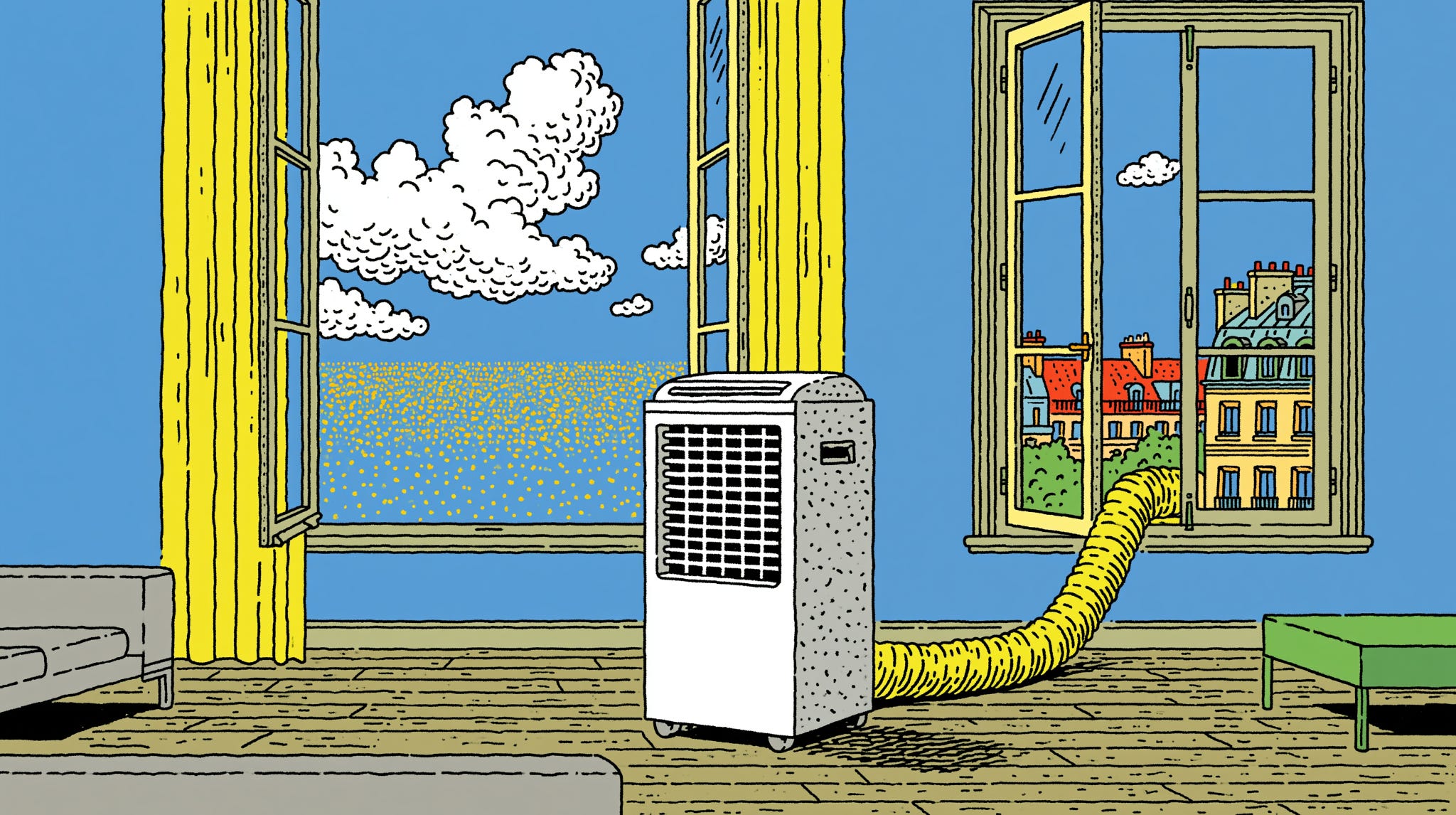
Customers then began to wonder whether they might also make their homes as comfortable as the stores they visit. Air-conditioners are now flying off the shelves in Europe; in Germany, sales increased 75% from 2019 to 2024. Individual units are, of course, the least efficient way to cool a home. Yet German regulations still make it virtually impossible to equip new residential buildings with central air-conditioning systems, even though these become more efficient every year. Landlords often refuse to permit tenants to install a “split” air-conditioner (where the loud compressor is installed on the outside of the building), since this requires drilling a hole through an exterior wall. Germans are thus forced to buy loud, inefficient “monoblock” units and vent the hot air through window ducts. More and more Germans are finding the comfort worth the cost. Meanwhile, onerous “net-zero by 2040” and budget regulations make it virtually impossible to install central air-conditioning in new government buildings, universities, or schools. Lee Kuan Yew once famously called air-conditioning “the key to public efficiency,” but Germany’s schools and government buildings remain locked.
Air-conditioning has now become a political issue. As their cities heat up, European voters are grasping that spray showers on the streets and ice-packs at home just don’t cut it anymore, in particular because they don’t reduce humidity. A heat wave in France in late May 2026 was so severe that the Prime Minister called an emergency cabinet meeting to address the issue. Populist-right leader Marine Le Pen took to Twitter once again to call a major effort to air-condition France: “Air-conditioning saves lives.” The center-right mayor of Meaux called Le Pen’s appeal “a joke” and, even worse in the eyes of European political elites, “an instance of populism.” The use of this potent insult even by the neo-Gaullist Les Républicains demonstrates that air-conditioning has now been deemed radioactive to all respectable mainstream opinion-makers.
Air-conditioning has also been ghettoized as a far-right hobbyhorse in Germany, where the right-wing AfD party, currently the nation’s largest, has vowed to abolish Germany’s many-tentacled colossus of climate-change regulations and subsidies entirely, pointing out that Germany’s contribution to worldwide CO2 emissions is trivial. Local party organizations are demanding that new hospitals, offices, and public buildings be air-conditioned as a matter of course. The embrace of air-conditioning by the populist right will only entrench the battle lines. There’s nothing right-wing European politicians despise more than regulations devised by Brussels bureaucrats with plump salaries and nobiliary particles in their last names. European politicians, for their part, would rather sacrifice their vacations than endorse a policy proposal soiled by association with the far right.
Yet even the most climate-aware Brussels official will hesitate before banning private air-conditioners, which continue to sell briskly all over Europe. The boom in air-conditioning in Europe is part of a worldwide trend. As hundreds of millions of people from the hottest parts of the Earth enter the middle class, one of their first purchases is invariably an air-conditioner. This disappoints many European tourists, who were expecting to admire “natural, culturally appropriate” adaptations to sweltering climes. No dice—it turns out that a preference for comfortable temperatures and moderate humidity is a cultural universal. And to humanity’s great good fortune, we now have small machines which can provide that blessing to billions of humans.

Andrew Hammel is a bilingual American lawyer, translator, and journalist based on Düsseldorf, Germany. He can be reached at ahammel@post.harvard.edu.


Europe has long justified its lower living standards as representative of some kind of personal strength or fortitude versus those decadent Americans, versus being a people having difficulty getting their scheiße, mierda, or merde together.
Lots of cultures have phobias about forced air. Look up “Korean fan death”.